When another car strikes your vehicle as you back out of a parking space in Buffalo, New York, you may share responsibility for the collision, but backing out does not automatically make you at fault. New York Vehicle and Traffic Law § 1211 requires safe reversing, and the actions of the driver traveling through the parking aisle also matter. Video, witness statements, vehicle positions, and driving behavior can help establish who caused the crash. If you were injured, New York no-fault benefits and the rules governing a personal injury lawsuit are separate issues.
The key question is whether each driver used reasonable care. If both drivers contributed, New York law may divide responsibility between them. Changes effective May 26, 2026, make the allocation of fault especially important in certain motor vehicle injury lawsuits.
Who Usually Has the Right of Way in a Buffalo Parking Lot?
A driver already traveling through a parking aisle generally has priority over a driver entering that aisle from a parking space. That principle does not give either driver unrestricted permission to continue. Each driver must respond reasonably to traffic, pedestrians, visibility, and the parking lot layout.
Under New York Vehicle and Traffic Law § 1211(a), a driver must make sure a backing movement can be completed safely without interfering with other traffic. Depending on the location and character of the parking lot, other Vehicle and Traffic Law provisions may also apply.
Before reversing, you should:
- Check mirrors and blind spots and look over your shoulder when possible.
- Look for pedestrians, shopping carts, and approaching vehicles.
- Back out slowly while continuing to monitor both directions.
- Stop if another vehicle enters the path of your car.
- Wait until there is enough room to finish the movement safely.
Reverse lights signal your intended movement, but they do not establish the right of way. Likewise, a driver in the aisle still has a responsibility to pay attention and adjust to a visible hazard.









Is the Driver Backing Out Always Responsible for the Collision?
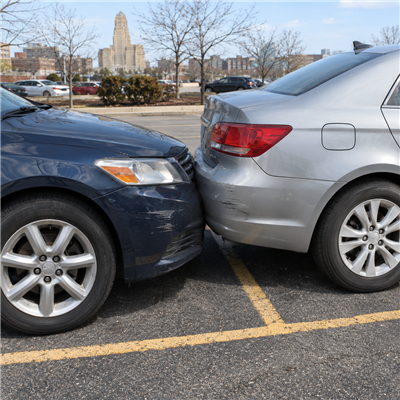
No. The driver backing out may bear most of the fault, some of the fault, or none of the fault, depending on the evidence. A collision involving a reversing vehicle is not proof by itself that the reversing driver caused the crash.
Consider a driver at an Amherst shopping center who checks for traffic, begins to reverse, then stops upon seeing a car approach. If the other driver is distracted and hits the stopped vehicle, the stopped position and the approaching driver’s behavior may be important evidence.
In another example, a driver slowly backs out at a Cheektowaga plaza when the aisle appears clear, while an approaching motorist drives too fast for the crowded conditions. An investigation may reveal mistakes by both drivers. These examples are illustrations, not determinations of fault in an actual claim.
Practical takeaway: The fact that your car was in reverse does not settle fault. What each driver did immediately before impact matters more.
Related Videos
Common Mistakes After a Car Accident
Who Pays to Fix My Car?
Can Both Drivers Be Responsible for a Parking Lot Accident?
Yes. Suppose you back out without checking carefully while another motorist drives through the aisle at an unsafe speed. Both choices could contribute to the collision. Investigators would examine whether the other motorist had time to respond and whether you had a clear view before moving.
For motor vehicle personal injury actions subject to New York Insurance Law Article 51 and commenced on or after May 26, 2026, CPLR § 1411(b) generally bars a claimant’s recovery when the claimant’s share of culpable conduct is greater than the combined culpable conduct of the defendants. At 50% fault or less, a claimant may still recover otherwise available damages, reduced by the claimant’s share of fault.
For example, if a qualifying claim has $100,000 in otherwise recoverable damages and you are found 30% responsible, the comparative-fault reduction would yield $70,000, before any other legal adjustments. If you are found 51% responsible in a qualifying action against a driver who is 49% responsible, the new rule may bar recovery in that action.
This rule does not automatically decide first-party no-fault benefits, every property damage claim, or actions commenced before the amendment. The date the lawsuit begins can matter even when the accident occurred earlier.
Our attorneys discuss these issues in the context of Buffalo motor vehicle injury claims: Buffalo car accident lawyers
What Happens When Two Vehicles Back Out at the Same Time?
When two vehicles reverse from opposite parking spaces, each driver must check the aisle and back safely. Neither driver automatically avoids responsibility because both cars were moving backward.
Evidence can show which vehicle moved first, whether one driver stopped, and whether either driver had a reasonable opportunity to avoid the impact. Rear-bumper damage may be consistent with two reversing vehicles, while damage along the side of one car may indicate a different sequence. Damage location alone is not definitive.
What Evidence Helps Determine Responsibility After a Parking Lot Crash?
Parking lot collisions frequently produce competing accounts. Evidence gathered soon after the crash can clarify the sequence of events:
- Surveillance footage: Cameras at stores, garages, or shopping centers may show vehicle movements.
- Photographs: Images of damage, parking-space markings, sightlines, and the aisle layout can preserve scene details.
- Witness statements: Independent observers may identify which driver moved or stopped first.
- Dashcam recordings: Video can document speed, braking, and the time available to react.
- Police documentation: A report may record observations and statements, although it does not conclusively decide civil liability.
- Physical evidence: Debris and damage patterns may help an investigator reconstruct the collision.
If both drivers in a Tonawanda parking lot say they were stationary, footage showing one vehicle reversing at impact could help settle that factual dispute. Store surveillance systems may overwrite recordings, so prompt preservation requests can matter.
Verdicts & Settlements
Does New York No-Fault Insurance Cover Parking Lot Accident Injuries?
Often, yes. Eligible injuries arising from a covered motor vehicle accident in a Buffalo parking lot can qualify for no-fault benefits regardless of who caused the collision. An eligible driver or passenger generally seeks benefits through the insurer of the vehicle occupied, subject to exceptions.
Basic no-fault protection generally provides up to $50,000 per eligible person for covered economic losses. Depending on statutory conditions, benefits may include medical care, rehabilitation, part of lost earnings, and certain necessary accident-related expenses.
No-fault insurance ordinarily does not pay for damage to your vehicle. Vehicle repairs are generally addressed through collision coverage or a property damage claim against a responsible party.
Written notice to the applicable no-fault insurer is generally required as soon as reasonably practicable and no later than 30 days after the accident, unless a clear and reasonable justification supports a late notice. A police report does not replace the no-fault claim notice.
To discuss insurance notice requirements and your circumstances, visit the firm’s case evaluation page: Free case evaluation
Can You Sue After Being Injured in a Parking Lot Collision?
You may be able to pursue a personal injury lawsuit when another driver’s negligence causes your injuries and you satisfy the requirements for the type of damages requested. In many covered New York automobile cases, a claim for pain and suffering requires a “serious injury” under Insurance Law § 5102(d).
The remaining statutory categories include fractures, significant disfigurement, permanent loss of use, permanent consequential limitation, and significant limitation of use, among other categories. For actions and proceedings commenced on or after May 26, 2026, the Legislature removed the former category involving nonpermanent injuries that substantially limited usual activities for at least 90 of the first 180 days after an accident.
The medical evidence and the date an action was commenced can affect the analysis. Most negligence-based personal injury lawsuits in New York have a three-year limitations period, but exceptions and shorter deadlines can apply. A lawyer can evaluate the deadline and whether the serious-injury threshold applies to your claim.
Related Videos
Should I Take The First Settlement Offer?
Steps to File a Personal Injury Claim
What Should You Do Immediately After a Buffalo Parking Lot Accident?
Your safety and medical needs come first. Call 911 for emergency assistance when someone is injured or when the circumstances require police assistance. Once you are safe, take these steps:
Exchange contact, registration, and insurance details with the other driver.
Photograph both vehicles, the parking spaces, nearby signs, and damage from several angles.
Collect witness names and contact information.
Ask nearby businesses to preserve relevant surveillance footage.
Obtain medical attention for pain or injury symptoms and keep records of treatment.
Notify the applicable insurance carrier promptly and preserve claim correspondence.
Review the consequences of any settlement or release before signing.
New York requires a DMV crash report within 10 days when an accident causes injury, death, or damage exceeding $1,000 to the property of any one person. The reporting obligation is separate from notifying your insurer. Symptoms such as neck or back pain may become more noticeable after a collision, so accurate medical documentation can be useful.
What if the Insurance Company Blames You for Backing Out?
An adjuster may initially rely on the reversing driver’s duty to back safely. You can still present facts showing that another driver was speeding, distracted, or failed to respond reasonably to a visible hazard.
Keep copies of video, photographs, medical records, estimates, and communications. Ask how the insurer reached its conclusion, and correct factual mistakes with supporting evidence. A Buffalo car accident lawyer can evaluate the dispute and explain how any shared-fault finding may affect available claims.

The team is very personable, patient and empathetic with their clients. They are upfront with you and will explain the entire process with you, they never lead you to believe otherwise, they tell you like it is and will not sell you a million dollar dream. Trust in Andrews, Bernstein & Maranto, PLLC, they work for you and he looks out for your best interest.”
- Jane D.
Speak With a Buffalo Car Accident Attorney About Your Parking Lot Collision
After a parking lot collision, you deserve to understand who may be responsible, which insurance benefits apply, and what evidence can support your claim. Andrews, Bernstein & Maranto, PLLC has represented injured people in Western New York since 1999 and focuses on personal injury matters.
From 420 Franklin Street, Buffalo, NY 14202, the firm assists people in Buffalo, Amherst, Cheektowaga, Tonawanda, and nearby Western New York communities. For guidance on an injury involving a vehicle backing out of a parking space, call the firm or use the firm’s online case evaluation page.
For more information about the attorneys who may assist with your claim, visit: Buffalo personal injury lawyers

Benjamin J.
Andrews
Partner

Robert
Maranto
Partner

Tom
Kotrys
Partner

Robert J.
Maranto, III
Attorney

Thanon
Rezvi
Attorney

Rea Marcelo
Roxas
Attorney
This article provides general information and is not legal advice. An attorney can explain the law as it applies to your specific circumstances.