A deer-related car accident in Western New York can create two separate insurance questions: who pays for vehicle damage, and who pays for injuries. If you hit a deer directly, comprehensive coverage on your own auto policy is usually the first coverage to review for damage to your vehicle, subject to the policy terms and deductible. If you are injured, New York no-fault benefits may cover qualifying medical expenses and part of your lost earnings. If another driver’s negligence contributed to the collision, a separate liability claim may also be available. Andrews, Bernstein & Maranto, PLLC helps injured drivers and passengers in Buffalo, New York, Erie County, Niagara County, and nearby Western New York communities understand which coverage may apply after a serious collision.
Deer crashes are especially relevant in this region during the fall. New York DMV reported 32,287 crashes involving deer statewide in 2024, including 1,001 in Erie County. The largest statewide monthly totals occurred in October, November, and December. For Western New York drivers, the insurance outcome depends on how the crash happened, whether the vehicle struck the deer directly, whether another object or vehicle was involved, and whether another driver’s conduct contributed to the collision.





Why Deer Collisions Increase During Fall in Western New York 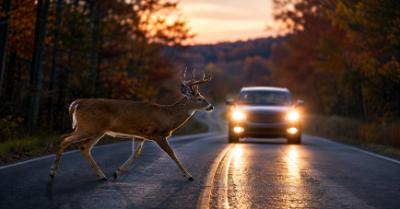
Deer collisions increase during fall in Western New York because deer become more active during the breeding season. New York officials warn that deer movement often peaks around dawn and dusk, which are also times when visibility can be reduced.
That risk can affect rural and suburban roads across Erie County, Niagara County, Wyoming County, Cattaraugus County, and nearby Western New York areas.
If you see one deer, reduce your speed and watch for others because deer often travel in groups. New York officials also advise drivers to brake firmly rather than make a sudden swerve. Swerving can turn an animal encounter into a collision with a guardrail, tree, utility pole, oncoming vehicle, or another car.
For related guidance about difficult driving conditions, see Car Accidents in Bad Weather:
https://www.wnyinjurylawyers.com/car-accidents-in-bad-weather/
Who Pays When Your Car Hits a Deer Directly?
When your vehicle hits a deer directly, your own comprehensive auto coverage is usually the first coverage to review for physical damage to your vehicle. New York Department of Financial Services guidance identifies hitting or being hit by an animal as a type of loss covered by comprehensive coverage.
Comprehensive coverage is different from liability coverage. New York requires liability insurance, but liability coverage pays for covered injuries or property damage you cause to others. It does not pay to repair your own vehicle after a deer strike simply because you carry liability insurance.
Comprehensive coverage is optional in New York. If you purchased it, your insurer may pay for covered damage after applying the deductible stated in your policy. If you do not have comprehensive coverage, you may have to pay for your own vehicle damage unless another legally responsible source of coverage applies.
For more information about vehicle damage after a New York crash, see Property Damage in NY:
https://www.wnyinjurylawyers.com/property-damage-in-ny/
A direct deer strike and a crash that happens while avoiding a deer can involve different vehicle-damage coverages. The exact coverage depends on how the crash occurred and the terms of the policy.
Partner Partner Partner Attorney Attorney Attorney
Benjamin J.
Andrews
Robert
Maranto
Tom
Kotrys
Robert J.
Maranto, III
Thanon
Rezvi

Rea Marcelo
Roxas
What If You Swerve to Avoid the Deer?
If you swerve to avoid a deer and your vehicle does not actually hit the animal, the insurance analysis can change. If you strike a guardrail, tree, parked car, another vehicle, or another object, your insurer may treat the damage as a collision loss rather than a comprehensive animal-strike claim.
Another driver can create an additional layer of responsibility. Examples include:
- You brake for a deer and a driver behind you rear-ends your vehicle because that driver was following too closely.
- Another driver swerves across the center line to avoid a deer and strikes you head-on or sideswipes your vehicle.
- A driver changes lanes suddenly after seeing a deer and forces your vehicle off the roadway.
- A driver is speeding, distracted, or impaired and cannot respond safely when traffic slows for wildlife.
In these situations, the deer may explain why traffic changed suddenly, but the animal’s presence does not automatically excuse unsafe driving. Fault may depend on speed, following distance, lane position, distraction, visibility, traffic conditions, and whether each driver acted reasonably under the circumstances.
The team is very personable, patient and empathetic with their clients. They are upfront with you and will explain the entire process with you, they never lead you to believe otherwise, they tell you like it is and will not sell you a million dollar dream. Trust in Andrews, Bernstein & Maranto, PLLC, they work for you and he looks out for your best interest.” - Jane D.
Can Another Driver Be Liable Even If a Deer Started the Emergency?
Another driver can be liable when a deer starts the emergency if that driver’s negligent conduct contributes to a second collision.
Imagine that you are driving near Orchard Park, New York, at dusk. A deer runs across the road, and you brake. The driver behind you is looking at a phone and does not slow in time. The deer created the need to brake, but the rear-end impact may still support a separate negligence claim against the distracted driver.
A similar issue can arise when another driver swerves into your lane. The key question is whether that driver’s conduct contributed to your injuries or property damage.
Evidence can be especially important in these cases. Police reports, witness statements, dash-camera footage, vehicle damage patterns, roadway photographs, electronic vehicle data, and nearby surveillance footage may help show what happened before and after the deer entered the roadway.
For more information about fault after a collision, see Who Is at Fault in an Accident:
https://www.wnyinjurylawyers.com/who-is-at-fault-in-an-accident/
Does New York No-Fault Insurance Cover Injuries From a Deer Crash?
New York no-fault insurance can cover qualifying injury-related losses after a deer crash. No-fault coverage addresses eligible medical expenses, a portion of lost earnings, and certain necessary expenses after a motor vehicle accident without requiring you to prove that another driver caused the crash. It does not pay for repairs to your vehicle.
You may have a no-fault claim after a deer collision even when there is no negligent driver to sue.
No-fault deadlines can begin quickly. New York rules generally require written notice of a claim within 30 days after the accident. Medical bills generally must be submitted within 45 days, and lost-earnings claims generally must be submitted within 90 days, subject to applicable rules and possible exceptions.
For more information about these deadlines, see No Fault Application Time Frame:
https://www.wnyinjurylawyers.com/no-fault-application-time-frame/
If another driver negligently contributed to the collision, you may also have a liability claim for losses that are not payable through no-fault. New York law generally limits recovery for non-economic loss, such as pain and suffering, unless the legal serious-injury requirement is met. The facts, available coverage, and type of damages can affect which claims are available.
Should I Take The First Settlement Offer? Steps to File a Personal Injury ClaimRelated Videos
What Should You Do After a Deer-Related Crash?
After a deer-related crash, your first concern should be safety. Move the vehicle to a safer location if you can do so without creating another hazard. Turn on the hazard lights, stay aware of passing traffic, and do not approach an injured deer. A frightened or wounded animal can move suddenly and cause additional injury.
Call the police when someone is hurt, the roadway is blocked, the animal creates a traffic hazard, or the crash otherwise requires emergency assistance.
New York DMV requires a motorist crash report when a collision causes injury or death or causes more than $1,000 in damage to the property of any one person. The report generally must be filed within 10 days.
When it is safe and your physical condition allows, preserve evidence and records:
- Photograph the vehicle damage, roadway, shoulder, debris, lane markings, signs, and surrounding area.
- Record the exact location, date, and time.
- Save dash-camera footage before it is overwritten.
- Exchange driver and insurance information if another vehicle was involved.
- Get witness names and contact information.
- Keep towing bills, repair estimates, medical bills, and insurance correspondence.
- Seek appropriate medical care for injuries or symptoms.
For more guidance, see First Things To Do After An Auto Accident:
https://www.wnyinjurylawyers.com/first-things-to-do-after-an-auto-accident/
Verdicts & Settlements
When a Deer Crash Causes More Than Vehicle Damage
A deer crash can cause much more than vehicle damage. A direct strike may cause airbag deployment, broken glass, loss of control, a rollover, or a secondary impact with another vehicle or roadside object.
Drivers and passengers can suffer neck injuries, back injuries, fractures, head injuries, shoulder injuries, or other trauma. Symptoms are not always obvious at the scene. Seek appropriate medical care and keep records of treatment, work restrictions, missed income, and accident-related expenses.
Talk With a Western New York Car Accident Lawyer
A Western New York car accident lawyer can review a deer-related crash when you are dealing with vehicle repairs, insurance deductibles, medical care, missed work, or questions about whether another driver shares responsibility.
Andrews, Bernstein & Maranto, PLLC serves injured people from its Buffalo office at 420 Franklin Street, Buffalo, NY 14202, and represents clients throughout Western New York and nearby areas. The legal team can review how the crash happened, identify potentially available insurance coverage, preserve evidence, and evaluate whether another driver’s conduct may support a personal injury claim.
Learn more about the firm’s car accident practice:
https://www.wnyinjurylawyers.com/buffalo-car-accident-lawyers/
Contact the firm:
https://www.wnyinjurylawyers.com/contact-us/
Call (716) 333-5525:
tel:+17163335525
This article is for informational purposes only and is not legal advice. Consult an attorney about your specific situation.