A leash can be important evidence of control and negligence, but it does not automatically establish or defeat a New York dog-injury claim. For an injured person, the first challenge is identifying the conduct that produced the harm. Andrews, Bernstein & Maranto, PLLC investigates that question for clients in Buffalo, Western New York, and nearby areas. Leash evidence matters most when it connects a choice about control to the way the injury occurred. A snapped leash tells a different story from a properly held short leash, and an open door may matter more than leash use in another case.
Picture a hypothetical event in which a dog pulls free on a sidewalk, escapes through an open door, or reaches someone because a long leash was not controlled. A claim should trace the sequence with records and physical proof before assigning legal fault. The setting may explain the risk, but it does not decide the case alone.
How a Leash Can Change the Liability Analysis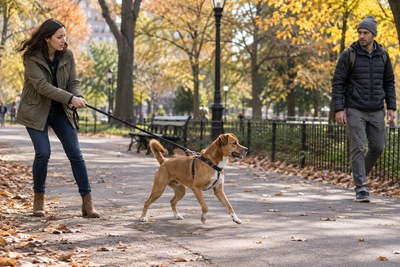
Potential responsibility should be mapped before anyone assumes that the most visible person is the only defendant. In Buffalo sidewalks, Erie County parks, apartment common areas, and residential neighborhoods across Western New York, ownership and control can be divided among several people or businesses.
The owner or person controlling the dog may face strict liability if that person knew or should have known of a dangerous tendency that caused the injury.
Since the New York Court of Appeals decided Flanders v Goodfellow in 2025, an injured person may also pursue ordinary negligence by showing a failure to use reasonable care under the circumstances.
A landlord, property manager, sitter, trainer, or business may be relevant only when the facts establish a duty and a negligent act or legally sufficient knowledge.
A leash violation can be evidence of poor control. It does not by itself answer causation, damages, duty, or every element of civil liability.
A lawyer can compare contracts, insurance policies, ownership records, job duties, and witness accounts. That work helps identify who owed a duty, who controlled the risk, and which coverage may answer for a proven loss.

The team is very personable, patient and empathetic with their clients. They are upfront with you and will explain the entire process with you, they never lead you to believe otherwise, they tell you like it is and will not sell you a million dollar dream. Trust in Andrews, Bernstein & Maranto, PLLC, they work for you and he looks out for your best interest.”
- Jane D.
The Two Current Paths to a New York Dog Injury Claim
The 2025 Court of Appeals decision Flanders v Goodfellow establishes two possible paths for harm caused by a domestic animal. A plaintiff may pursue strict liability by proving the owner knew or should have known of a vicious propensity that caused the injury. A plaintiff may instead, or also, pursue ordinary negligence by proving a failure to use reasonable care under the circumstances.
A vicious propensity is broader than a prior bite. Lunging, snapping, territorial conduct, forceful pulling, aggressive barking directed at visitors, or a tendency to escape may matter when similar to the behavior that caused the injury. Breed alone does not prove the required knowledge, and a calm history does not automatically defeat a fact-specific negligence claim after Flanders.
Legal rules must be applied to the proof in the individual case. This article provides general information and does not replace advice about a specific incident.

Benjamin J.
Andrews
Partner

Robert
Maranto
Partner

Tom
Kotrys
Partner

Robert J.
Maranto, III
Attorney

Thanon
Rezvi
Attorney

Rea Marcelo
Roxas
Attorney
What Prior Behavior Can Show
Good evidence records both the hazard and the timeline. A close photograph may show the condition, while a wider image explains visibility, traffic flow, lighting, warnings, and available routes. Original digital files are better than screenshots because they retain time and device information.
Records can be overwritten or discarded under routine retention practices. A preservation request can identify video, electronic data, maintenance documents, contracts, and physical items before they disappear. Medical records should also connect the diagnosis and treatment to the date and mechanism of the incident.
- the leash, collar, or harness
- photos of the location
- animal-control and veterinary records
- prior complaints
- messages about the dog’s behavior
- witness accounts
Related Videos
Should I Take The First Settlement Offer?
Steps to File a Personal Injury Claim
When Other People or Property Defendants May Be Involved
The physical setting may include no leash, a leash too long for the setting, a broken clasp, failure to secure a doorway, and known lunging or territorial behavior. Each feature has to be connected to a duty and to the way the incident occurred. A condition that merely appears in a later photograph may not establish what existed at the critical time.
Common disputes include the dog had never bitten anyone; the injured person startled the animal; a local leash rule does not create civil liability; another person had temporary control.
Comparative fault requires evidence about what the injured person could reasonably see and do. A warning, an open condition, or an alternative route may matter, but those facts do not erase a defendant’s negligence automatically. Fault allocation depends on the rule governing the claim and the strength of the proof.
Evidence That Can Establish Control and Causation
Your health comes first. Once immediate medical needs are addressed, practical steps can protect information that may otherwise be lost. Do not place yourself in danger to take a photograph or confront another person.
Give accurate facts in reports and medical histories. Avoid guessing about speed, timing, ownership, or the precise legal cause. A later investigation can answer those questions using records and qualified analysis.
- wash the wound and obtain prompt medical care
- identify the dog and owner
- report the incident to the proper local authority
- photograph injuries over time
- save damaged clothing and obtain witness information
Verdicts & Settlements
Questions an Investigation Should Answer
The investigation should test the event from more than one viewpoint. It should ask when the risk first appeared, who was present, what inspections or warnings occurred, and whether no leash was visible before the incident. It should also compare written policies with what people actually did.
A useful reconstruction does not begin with a preferred defendant. It begins with the scene, the sequence, and the records. In this topic, the key documents may explain why known lunging or territorial behavior mattered, whether anyone had time to respond, and whether another cause better fits the physical evidence.
The same facts also help test causation. Investigators can compare witness timing, physical marks, photographs, and business records to decide whether a leash too long for the setting contributed to the event or merely happened to be nearby. That distinction keeps the claim focused on provable conduct and losses.
Time Limits and Available Insurance
Homeowners, renters, commercial, or other liability insurance may cover a dog injury depending on the policy and location. Damages can include medical care, lost income, scarring, functional limits, and pain and suffering when supported by evidence. Policy exclusions and reservations of rights need individual review.
Many New York personal-injury lawsuits fall under the three-year limitations provision in CPLR 214. That is not a universal deadline. A public defendant can trigger a notice of claim that is commonly due within 90 days under General Municipal Law Section 50-e, and wrongful-death, minor, or other special claims follow different rules.
Prompt investigation remains valuable even when a court deadline appears distant. Weather changes, video is overwritten, vehicles are repaired, seasonal sets are dismantled, and witnesses become harder to locate.
Talk With a Buffalo Dog Bite Lawyer About the Current Law
A lawyer can review how the incident happened, identify possible responsible parties, locate available insurance, preserve relevant evidence, assess the injuries, and determine which deadlines apply. The firm’s related resources on dog accidents and its dog guide resource can help you prepare for that discussion.
Andrews, Bernstein & Maranto, PLLC offers free consultations from its Buffalo office at 420 Franklin St., Buffalo, NY 14202. If you were injured in Buffalo, Western New York, or a nearby area, you can request a case review without a promise or pressure about the result.