
Earlier fall sunsets in Buffalo can put you, bicyclists, and drivers on the same streets after daylight has faded, even when daily schedules have not changed. Dusk can reduce contrast, create glare, deepen shadows, and make crossing or turning movements harder to judge. Rain, wet pavement, fallen leaves, parked vehicles, school traffic, and evening commuters can add to those visibility problems.
If you are struck while walking or riding a bicycle, lighting conditions can become part of the investigation into fault. Photographs, video, witness accounts, vehicle lights, bicycle lights, road design, traffic signals, weather conditions, and the exact time of the crash may help show what each person could reasonably see.
New York no-fault insurance may also cover qualifying medical expenses, lost earnings, and certain other economic losses when a motor vehicle strikes you while you are walking or cycling. Written notice of a no-fault claim generally must be provided within 30 days after the accident, subject to limited exceptions.
Low light does not decide who caused a crash. It can help explain what each person could see and whether reasonable care was used.










Why Earlier Fall Sunsets Change Buffalo Traffic 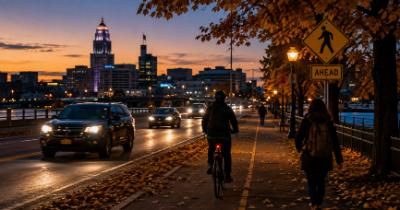
A route that feels familiar during summer can look very different in September, October, or November. You may leave work, school, an appointment, a store, or an evening activity at the same time every day, but the amount of available daylight can change substantially as fall progresses.
After daylight saving time ends in New York, sunset arrives about an hour earlier by the clock. That change can place more evening commuting, shopping, school activities, dog walking, running, and cycling into dusk or darkness.
The challenge is not limited to complete darkness. During dusk, the sky may still appear bright while pavement, sidewalks, crosswalks, bicycles, and people near the curb appear much darker. A driver may feel that visibility remains adequate even though a person in a shadowed area is harder to identify quickly.
Low-angle sunlight near sunset can create a different visibility problem. Glare through a windshield can reduce contrast and make traffic signals, pedestrians, bicyclists, and other vehicles harder to distinguish. A short time later, natural light may fade enough that headlights and streetlights become the main sources of visibility.
Fall Conditions Can Add to Low-Light Risks
Buffalo fall weather can change the way a street looks before full darkness arrives. Rain, damp pavement, overcast skies, and fallen leaves may make road markings and other visual cues harder to recognize.
Wet pavement can reflect headlights and streetlights. Leaves may cover portions of lane markings, bike-lane boundaries, curb lines, or surface defects.
Parked vehicles can create another sight-line problem. If you are walking, you may be difficult for an approaching driver to see before you move beyond a parked vehicle. If you are cycling beside parked cars, a turning driver may have only a short period in which to notice you.
School buses, delivery vehicles, rideshare stops, loading areas, and curbside pickups can create similar conflicts.
These conditions do not determine fault by themselves. They may affect what reasonable care required under the circumstances.
A driver may need to reduce speed, keep a careful lookout, and allow more time to react. A bicyclist riding during the period from one-half hour after sunset until one-half hour before sunrise must comply with New York bicycle lighting requirements. Pedestrians also have responsibilities involving traffic signals, crossings, and roadway safety.
Partner Partner Partner Attorney Attorney Attorney
Benjamin J.
Andrews
Robert
Maranto
Tom
Kotrys
Robert J.
Maranto, III
Thanon
Rezvi

Rea Marcelo
Roxas
Where Fall Pedestrian and Bicycle Crashes Can Happen
Low-light crashes can occur throughout Buffalo and nearby Western New York communities, but certain locations create recurring conflict points between vehicles, pedestrians, and bicyclists.
Examples include:
- Crosswalks where drivers are turning while watching approaching vehicle traffic
- Intersections where a bicyclist continues straight while a vehicle turns across the cyclist’s path
- Left-turn situations where a driver is watching opposing traffic and does not identify a pedestrian or bicyclist
- Driveways and parking lot exits where vehicles cross sidewalks or bicycle routes
- Streets where parked vehicles restrict sight lines
- School areas and bus stops where people frequently enter or leave the roadway
- Bike lanes where vehicles merge, turn, park, or load passengers
A driver stating that they did not see you does not automatically resolve the issue of fault. An investigation can examine whether you should have been visible through reasonable attention, appropriate speed, working lights, proper signaling, and a careful lookout.
For information about pedestrian accident claims in Buffalo:
https://www.wnyinjurylawyers.com/buffalo-pedestrian-accident-lawyers/
For information about bicycle accident claims in Buffalo:
https://www.wnyinjurylawyers.com/buffalo-bicycle-accident-lawyers/
The team is very personable, patient and empathetic with their clients. They are upfront with you and will explain the entire process with you, they never lead you to believe otherwise, they tell you like it is and will not sell you a million dollar dream. Trust in Andrews, Bernstein & Maranto, PLLC, they work for you and he looks out for your best interest.” - Jane D.
What Evidence Can Show Visibility at the Time of the Crash
A photograph taken in daylight several days after a collision may not show what you, the driver, or witnesses could see when the crash happened. Natural light can change quickly around sunset, and temporary traffic or weather conditions may disappear.
Evidence that may help document the scene includes:
- Photographs taken at or near the time of the collision
- Wide photographs showing the roadway, crosswalk, bicycle lane, parked vehicles, and sight lines
- Surveillance video from nearby businesses, residences, buses, or other properties
- Dash camera or vehicle camera footage
- Witness names and contact information
- The exact time and location of the collision
- Weather and pavement conditions
- Headlight, taillight, bicycle light, and reflector condition
- Vehicle and bicycle damage
- Police reports
- Medical records documenting your injuries
If your physical condition allows, you may also photograph the location at approximately the same time of day on a later date. You should not enter traffic or attempt to recreate the crash. The purpose is to document how the location appears under similar natural-light conditions.
Video can be especially time-sensitive because some recording systems automatically overwrite older footage.
Should I Take The First Settlement Offer? Steps to File a Personal Injury ClaimRelated Videos
Fault Can Be Disputed After a Dusk Accident
Pedestrian and bicycle crashes can produce very different accounts of the same event. A driver may claim that someone entered the roadway suddenly. You may report that a vehicle turned through a crosswalk without yielding. A bicyclist may report that a driver crossed a bicycle lane, turned across the rider’s path, or opened a vehicle door in front of the bicycle.
New York changed its comparative-fault rules for certain motor vehicle personal injury cases in 2026. In personal injury actions subject to Article 51 of the Insurance Law, being more than 50 percent at fault can bar recovery. If your share of fault is 50 percent or less, recoverable damages may be reduced according to your percentage of responsibility.
That makes the investigation of visibility, timing, traffic signals, vehicle movement, bicycle equipment, witness statements, and available video especially significant.
A traffic ticket, dark clothing, crossing location, bicycle-light issue, or statement that someone was difficult to see should not be treated as the complete liability analysis. The surrounding facts still need to be evaluated under the law that applies to the claim.
More information about pedestrian accident fault is available here:
https://www.wnyinjurylawyers.com/pedestrian-accident-fault/
More information about bicycle accident liability is available here:
https://www.wnyinjurylawyers.com/bicycle-accident-liability/
New York No-Fault Insurance May Apply
If a motor vehicle strikes you while you are walking or riding a bicycle in New York, no-fault coverage may provide benefits for qualifying economic losses regardless of who caused the collision.
Depending on the circumstances, benefits may include qualifying medical and rehabilitation expenses, a portion of lost earnings, and certain other reasonable and necessary expenses related to the injury.
When the vehicle that struck you is identified and insured, the no-fault claim is generally presented to that vehicle’s insurer. Different procedures can apply when the vehicle is uninsured or cannot be identified.
Written notice of a no-fault claim generally must be provided no later than 30 days after the accident. A late filing may be accepted when written proof establishes a clear and reasonable justification, but you should not rely on an exception when timely filing is possible.
More information about the filing period is available here:
https://www.wnyinjurylawyers.com/no-fault-application-time-frame/
No-fault benefits and a personal injury liability claim serve different purposes. No-fault coverage primarily addresses qualifying economic losses. A separate claim against an at-fault party may address other damages when the legal requirements are satisfied.
New York’s serious injury rules can also affect whether certain non-economic damages, including pain and suffering, may be pursued after a motor vehicle accident.
Verdicts & Settlements
What to Do After a Fall Pedestrian or Bicycle Accident
Your health comes first after a collision. Call 911 when you are injured, another person may be injured, or the scene presents a safety risk. Seek appropriate medical care and describe your symptoms accurately.
When you can act safely:
- Get the driver’s name, vehicle information, and insurance information.
- Photograph the vehicle, bicycle, roadway, crosswalk, traffic signals, signs, lighting, and surrounding area.
- Ask witnesses for their names and contact information.
- Note nearby businesses, homes, buses, or vehicles that may have cameras.
- Keep your damaged bicycle, helmet, clothing, lights, reflectors, bags, glasses, and other relevant personal property.
- Save medical records, bills, wage records, and insurance correspondence.
- Write down what you remember about the lighting, weather, traffic, and vehicle movements while the details are fresh.
- Avoid guessing about speed, distance, visibility, or fault when you do not know the answer.
- Do not place yourself in traffic to photograph or inspect the scene.
Evidence can disappear quickly. Early documentation can make later questions about lighting, visibility, and vehicle movement easier to evaluate.
Talk With a Buffalo Pedestrian or Bicycle Accident Lawyer
A pedestrian or bicycle collision can leave you dealing with medical treatment, time away from work, damaged property, insurance paperwork, and questions about responsibility.
Andrews, Bernstein & Maranto, PLLC handles pedestrian and bicycle accident matters and can review the circumstances of your collision, identify potential insurance issues, evaluate available evidence, and explain deadlines that may affect your claim.
The Buffalo office is located at:
420 Franklin Street
Buffalo, NY 14202
The firm serves injured people in Buffalo, Erie County, Western New York, and nearby communities.
Call (716) 333-5525:
tel:+17163335525
You can also request a consultation here:
https://www.wnyinjurylawyers.com/contact-us/
This article is for informational purposes only and is not legal advice. Consult an attorney about your specific situation.