
Liability for a school zone crash in Buffalo depends on what caused the collision and who contributed to it. A negligent driver is often the primary responsible party, but a vehicle owner, employer, school bus operator, transportation contractor, school district, municipality, road contractor, or another party may also share responsibility when its conduct helped cause the crash.
New York school-zone speed rules, school-bus stopping laws, vehicle-owner liability, no-fault insurance rules, comparative-fault rules, and filing deadlines can all affect an injury claim. Andrews, Bernstein & Maranto, PLLC helps injured people and families in Buffalo, Erie County, Western New York, and nearby areas identify responsible parties, available insurance coverage, time-sensitive evidence, and filing requirements that may apply.
A crash happening in a school zone does not automatically make a school or municipality liable. Responsibility depends on who caused or contributed to the collision and what legal duties applied.




Why School Zone Crashes Can Involve More Than One Responsible Party 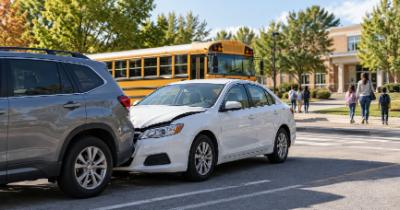
School arrival and dismissal bring many types of traffic into the same area. Parents enter pickup lines, school buses stop to receive or discharge passengers, children cross streets, bicyclists travel near schools, and other drivers move through the neighborhood.
A collision can involve two cars, several vehicles, a pedestrian, a bicyclist, or a school bus. The location alone does not determine liability. The central question is whose conduct caused or contributed to the crash.
The Driver Who Caused the Crash
A driver may be liable when careless conduct causes a school zone collision. Examples can include:
- Speeding
- Texting or using a phone while driving
- Following too closely
- Failing to yield
- Backing without checking for children or other road users
- Running a stop sign
- Turning across a crosswalk without yielding
- Driving too fast for congested or hazardous conditions
New York Vehicle and Traffic Law Section 1180 requires drivers to obey an established school speed limit during the times stated on the school-zone sign or while qualifying school-zone beacons are flashing. The statute also requires drivers to travel at a reasonable and prudent speed based on actual and potential hazards.
A driver can therefore be negligent even while traveling at or below the posted maximum when traffic, pedestrians, visibility, weather, or other conditions require greater caution.
For information about how motor vehicle claims are investigated, visit:
https://www.wnyinjurylawyers.com/buffalo-car-accident-lawyers/
Partner Partner Partner Attorney Attorney Attorney
Benjamin J.
Andrews
Robert
Maranto
Tom
Kotrys
Robert J.
Maranto, III
Thanon
Rezvi

Rea Marcelo
Roxas
Drivers Who Pass a Stopped School Bus
A school zone crash may involve a driver who fails to stop for a school bus. New York Vehicle and Traffic Law Section 1174 requires a driver approaching a properly marked and equipped school bus from either direction to stop when the bus has stopped to receive or discharge passengers, or because a school bus in front of it has stopped for that purpose, and the required red visual signal is operating.
The driver must remain stopped until the school bus resumes motion or until the school bus driver or a police officer signals that traffic may proceed.
A violation can become important evidence in a civil injury claim when it contributed to a collision or pedestrian injury. Investigators may examine the bus lights, stop location, traffic pattern, roadway layout, driver visibility, witness accounts, and available video.
For information about bus injury claims, visit:
https://www.wnyinjurylawyers.com/buffalo-bus-accident-lawyers/
The Vehicle Owner May Share Liability
The person driving the vehicle may not be its owner. Under New York Vehicle and Traffic Law Section 388, a vehicle owner can be responsible for injuries caused by the negligence of a person who was operating the vehicle with the owner’s express or implied permission.
This rule can matter when a parent owns a vehicle driven by a teenager, a business owns a vehicle used by an employee, or another person allowed the driver to use the vehicle.
Ownership records, registration information, insurance policies, and permission to use the vehicle should be reviewed before concluding that only the driver may be responsible.
The team is very personable, patient and empathetic with their clients. They are upfront with you and will explain the entire process with you, they never lead you to believe otherwise, they tell you like it is and will not sell you a million dollar dream. Trust in Andrews, Bernstein & Maranto, PLLC, they work for you and he looks out for your best interest.” - Jane D.
When an Employer or Transportation Company May Be Responsible
School-zone traffic can include delivery vehicles, service trucks, rideshare vehicles, school buses, and other vehicles operated for work.
An employer may be responsible for an employee’s negligence when the employee was acting within the scope of employment at the time of the crash. A transportation company may also face separate questions about hiring, training, supervision, maintenance, routing, vehicle condition, or other company conduct when those issues contributed to the collision.
Useful records can include:
- Work schedules
- Dispatch records
- GPS information
- Driver qualification or training records
- Vehicle inspection and maintenance files
- Dash-camera or onboard video
- Company policies relevant to the trip
Can a School District or Municipality Be Liable?
A public school district or municipality is not responsible simply because a crash happened in a school zone. A claim may be possible when the public entity’s own negligent act or omission contributed to the injury, subject to governmental immunity rules, statutory requirements, and other defenses.
Depending on the facts, a claim could involve issues such as a crossing guard, school-controlled traffic flow, traffic-control measures, or a dangerous condition under the entity’s control.
Claims involving public entities can carry deadlines that are much shorter than the ordinary personal injury filing period. New York General Municipal Law Section 50-e generally requires a notice of claim within 90 days when that statute applies.
If a dangerous or defective street, highway, sidewalk, bridge, or crosswalk condition contributed to the injury, a separate prior-written-notice requirement may also matter, depending on the public entity and the condition involved.
School district and municipal claims can involve different statutes and procedural rules, so you should not assume that the ordinary filing deadline controls.
Should I Take The First Settlement Offer? Steps to File a Personal Injury ClaimRelated Videos
What If a Pedestrian, Parent, or Driver Is Partly at Fault?
More than one person can contribute to a school zone crash. New York changed its comparative-fault rule for certain motor-vehicle personal injury actions in 2026.
For actions and proceedings commenced on or after May 26, 2026, CPLR Section 1411(b) provides that, in a personal injury action subject to Article 51 of the Insurance Law, a claimant’s culpable conduct can bar recovery when it is greater than the culpable conduct of the person from whom recovery is sought or greater than the combined culpable conduct of the persons from whom recovery is sought.
When the claimant is not barred from recovery, the claimant’s share of fault can still reduce the damages that may be recovered.
Fault evidence is therefore especially important. A driver may contend that a pedestrian entered the roadway unexpectedly, while a pedestrian may contend that the driver ignored a crossing guard, failed to yield, or failed to reduce speed for school-zone conditions.
Those disputes may be evaluated through photographs, video, witness statements, traffic controls, vehicle data, and other evidence.
For information about pedestrian injury claims, visit:
https://www.wnyinjurylawyers.com/buffalo-pedestrian-accident-lawyers/
How New York No-Fault Insurance Fits Into a School Zone Crash
Liability and no-fault benefits are separate issues. New York’s no-fault system can provide first-party benefits for qualifying economic losses after many motor vehicle accidents without requiring the injured person to establish who caused the crash.
A separate claim for non-economic loss against another covered person generally requires a serious injury under Insurance Law Section 5104.
The correct source of no-fault benefits can depend on whether you were a driver, passenger, pedestrian, bicyclist, or bus occupant. More than one insurance policy may need to be reviewed.
Because the applicable policy and filing requirements depend on the facts, identifying all vehicles, owners, employers, and insurers can be an important early step.
Verdicts & Settlements
What Evidence Helps Establish Liability?
School-zone evidence can disappear quickly because traffic patterns change after arrival or dismissal, video can be overwritten, buses move to other routes, and witnesses can become harder to locate.
Useful evidence may include:
- Photographs of the vehicles, crosswalks, signs, traffic signals, sight lines, and road markings
- School, business, residential, dash-camera, or bus video
- Witness names and contact information
- Police and incident reports
- School bus route information, GPS data, stop-arm records, or onboard camera footage
- Vehicle event data and repair records
- Phone records when distraction is disputed
- Crossing-guard schedules or traffic-control records
- Employment, dispatch, or transportation-company records
- Medical records showing when symptoms began and how the injuries affected daily activities
- Records of school absences, missed work, transportation costs, and other accident-related losses
After medical needs are addressed, this resource explains practical steps that can help preserve information after a crash:
https://www.wnyinjurylawyers.com/first-things-to-do-after-an-auto-accident/
What Should You Do After a School Zone Accident?
Call 911 when anyone may be injured or the scene is unsafe. Seek prompt medical care, especially when a child is involved. A child may have difficulty describing headaches, dizziness, pain, fear, or changes in concentration after a collision.
If you can do so safely, photograph the scene before traffic patterns change. Get the driver’s name, vehicle owner’s information, insurance information, and witness contact information. Note nearby cameras, school bus numbers, road signs, signals, crosswalks, and any crossing guard who was present.
Keep relevant records together, including:
- Medical bills and treatment records
- School absence records
- Wage and employment information
- Transportation expenses
- Insurance letters and emails
- Photographs and videos
- Police or incident report information
Avoid guessing about fault in a recorded statement or public social media post. Preserve the facts and let the available evidence be evaluated.
A lawyer can request video, identify vehicle ownership, review insurance coverage, evaluate public-entity notice requirements, and determine whether multiple parties may share responsibility.
Talk With a Buffalo School Zone Accident Lawyer
A school zone crash can affect medical care, transportation, work schedules, and a child’s return to school at the same time. Andrews, Bernstein & Maranto, PLLC represents injured people and families from its Buffalo office at 420 Franklin St, Buffalo, NY 14202, and serves Buffalo, Erie County, Western New York, and nearby areas.
The firm can review how the collision happened, identify potentially responsible parties, preserve time-sensitive evidence, examine insurance coverage, and explain filing requirements that may apply to the claim.
To discuss your situation, call (716) 333-5525 or visit:
https://www.wnyinjurylawyers.com/contact-us/
This article is for informational purposes only and is not legal advice. Consult an attorney about your specific situation.