Liability may extend beyond the driver when a carrier, employer, shipper, loading company, trailer owner, or equipment supplier helped place an unsecured load on the road. For an injured person, the first challenge is identifying the conduct that produced the harm. Andrews, Bernstein & Maranto, PLLC investigates that question for clients in Buffalo, Western New York, and nearby areas. A falling-cargo claim often depends on identifying the source vehicle before it leaves and preserving the load itself. Scrape marks, broken tie-downs, bills of lading, inspection entries, and video can connect debris in the road to the party that loaded or transported it.
Picture a hypothetical event in which lumber slides from a utility trailer into traffic, or a loose appliance falls from a box truck and forces a nearby driver to swerve. A claim should trace the sequence with records and physical proof before assigning legal fault. The setting may explain the risk, but it does not decide the case alone.
Who May Be Responsible for Fallen Cargo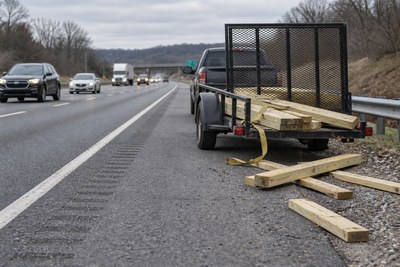
Potential responsibility should be mapped before anyone assumes that the most visible person is the only defendant. In the New York State Thruway, Route 33, I-190, I-290, and local delivery corridors across Buffalo and Western New York, ownership and control can be divided among several people or businesses.
The driver may be liable for beginning the trip without checking the load, continuing after straps loosened, or using a vehicle that was not suited to the cargo.
The motor carrier or driver’s employer may answer for work-related negligence and may face separate questions about loading procedures, training, supervision, dispatch, and required inspections.
A shipper, warehouse, loading contractor, trailer owner, rental company, or securement-equipment supplier may share responsibility when its own act or defective equipment helped release the cargo.
A following driver may also be evaluated for speed, distance, lookout, and reaction. A sudden object in the lane does not automatically prove that every response was negligent.
A lawyer can compare contracts, insurance policies, ownership records, job duties, and witness accounts. That work helps identify who owed a duty, who controlled the risk, and which coverage may answer for a proven loss.

The team is very personable, patient and empathetic with their clients. They are upfront with you and will explain the entire process with you, they never lead you to believe otherwise, they tell you like it is and will not sell you a million dollar dream. Trust in Andrews, Bernstein & Maranto, PLLC, they work for you and he looks out for your best interest.”
- Jane D.
Cargo Securement Rules and New York Negligence
Commercial cargo rules can supply important evidence of reasonable care. Federal cargo securement standards require covered commercial vehicles to be loaded and equipped so cargo does not leak, spill, blow, or fall, and so shifting cargo does not impair stability or maneuverability. Whether a violation supports civil liability still depends on the vehicle, the rule’s application, causation, and the proof.
Federal rules also require covered truck drivers to check securement before driving and to perform specified rechecks during transportation. Section 392.9 addresses the driver’s inspection duties and the carrier’s obligation not to require or permit operation with inadequately secured cargo. Records showing who loaded the vehicle and when the load was checked can be central evidence.
New York no-fault insurance is separate from fault. Basic no-fault coverage can pay qualifying medical expenses, lost earnings, and certain necessary expenses without first deciding who caused the crash. A claim for pain and suffering in a covered motor-vehicle case usually requires a serious injury, and current CPLR 1411 can affect recovery when the injured person’s conduct is also placed at issue.
Legal rules must be applied to the proof in the individual case. This article provides general information and does not replace advice about a specific incident.

Benjamin J.
Andrews
Partner

Robert
Maranto
Partner

Tom
Kotrys
Partner

Robert J.
Maranto, III
Attorney

Thanon
Rezvi
Attorney

Rea Marcelo
Roxas
Attorney
Evidence That Can Connect Debris to the Source Vehicle
Good evidence records both the hazard and the timeline. A close photograph may show the condition, while a wider image explains visibility, traffic flow, lighting, warnings, and available routes. Original digital files are better than screenshots because they retain time and device information.
Records can be overwritten or discarded under routine retention practices. A preservation request can identify video, electronic data, maintenance documents, contracts, and physical items before they disappear. Medical records should also connect the diagnosis and treatment to the date and mechanism of the incident.
- dash-camera and traffic-camera video
- the cargo and every strap, chain, hook, tarp, or fastener
- bills of lading and loading diagrams
- driver inspection records
- electronic logging and route data
- photographs of matching debris and the cargo vehicle
Related Videos
Should I Take The First Settlement Offer?
Steps to File a Personal Injury Claim
Common Defenses After an Unsecured Load Crash
The physical setting may include frayed or undersized tie-downs, an open tailgate, overloaded roof racks, poor weight distribution, uncovered loose material, and cargo that shifts during braking or a turn. Each feature has to be connected to a duty and to the way the incident occurred. A condition that merely appears in a later photograph may not establish what existed at the critical time.
Common disputes include an unknown vehicle dropped the object earlier; the load was secure when the trip began; a following driver reacted unreasonably; the shipper rather than the carrier controlled loading.
Comparative fault requires evidence about what the injured person could reasonably see and do. A warning, an open condition, or an alternative route may matter, but those facts do not erase a defendant’s negligence automatically. Fault allocation depends on the rule governing the claim and the strength of the proof.
What to Do Before the Cargo and Video Disappear
Your health comes first. Once immediate medical needs are addressed, practical steps can protect information that may otherwise be lost. Do not place yourself in danger to take a photograph or confront another person.
Give accurate facts in reports and medical histories. Avoid guessing about speed, timing, ownership, or the precise legal cause. A later investigation can answer those questions using records and qualified analysis.
- call 911 and move out of active traffic if possible
- photograph the debris without entering a dangerous lane
- record the truck, trailer, plate, company markings, and direction of travel
- identify witnesses and vehicles with dashboard cameras
- preserve damaged vehicle parts and notify the correct no-fault carrier
Verdicts & Settlements
Questions an Investigation Should Answer
The investigation should test the event from more than one viewpoint. It should ask when the risk first appeared, who was present, what inspections or warnings occurred, and whether frayed or undersized tie-downs was visible before the incident. It should also compare written policies with what people actually did.
A useful reconstruction does not begin with a preferred defendant. It begins with the scene, the sequence, and the records. In this topic, the key documents may explain why cargo that shifts during braking or a turn mattered, whether anyone had time to respond, and whether another cause better fits the physical evidence.
The same facts also help test causation. Investigators can compare witness timing, physical marks, photographs, and business records to decide whether an open tailgate contributed to the event or merely happened to be nearby. That distinction keeps the claim focused on provable conduct and losses.
Insurance Compensation and Filing Deadlines
No-fault benefits and a bodily-injury claim serve different purposes. No-fault can pay qualifying economic losses without proving fault, while liability coverage may address losses caused by another party. Property damage, collision, commercial, rideshare, and excess policies can add separate layers.
Many negligence lawsuits are subject to the three-year period in CPLR 214, but that statement has exceptions. A claim against a municipality or public authority may require a notice of claim, commonly within 90 days under General Municipal Law Section 50-e. Wrongful death, claims involving minors, and specialized defendants require separate review.
Prompt investigation remains valuable even when a court deadline appears distant. Weather changes, video is overwritten, vehicles are repaired, seasonal sets are dismantled, and witnesses become harder to locate.
Ask a Buffalo Truck Accident Lawyer to Trace the Load
A lawyer can review how the incident happened, identify possible responsible parties, locate available insurance, preserve relevant evidence, assess the injuries, and determine which deadlines apply. The firm’s related resources on truck accidents and its truck guide resource can help you prepare for that discussion.
Andrews, Bernstein & Maranto, PLLC offers free consultations from its Buffalo office at 420 Franklin St., Buffalo, NY 14202. If you were injured in Buffalo, Western New York, or a nearby area, you can request a case review without a promise or pressure about the result.