Payment can come from one or several insurance policies, but fault depends on the conduct that caused the crash. Delivery operations often involve layers that do not appear on a police report. The useful questions are who selected the route, who controlled the schedule, who owned the vehicle, who maintained it, and what the driver was doing at the moment of impact. Andrews, Bernstein & Maranto, PLLC helps injured people examine these fact-sensitive questions in Buffalo, Western New York, and nearby areas.
Consider this hypothetical example: a delivery van backing from an alley into a cyclist, or a box truck making a rushed turn across a crosswalk. The legal result turns on evidence, not the season or location label. A careful investigation connects a particular act, omission, property condition, or equipment failure to the injury.
Who May Have to Pay After a Delivery Truck Crash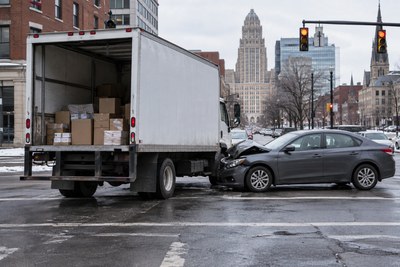
Potential responsibility should be mapped before anyone assumes that the most visible person is the only defendant. In busy delivery routes in Buffalo, Cheektowaga, Amherst, and nearby Western New York communities, ownership and control can be divided among several people or businesses.
The driver may be responsible for speeding, an unsafe turn, distracted driving, poor backing technique, or failure to yield.
A delivery company or direct employer may answer for an employee acting within the scope of work. Hiring, training, dispatch, and vehicle-maintenance choices can support separate negligence claims.
A vehicle owner, route contractor, loading company, repair shop, parts maker, or another motorist may share responsibility when the evidence supports that role.
A national brand is not automatically liable merely because its logo appeared on a package or vehicle. Contracts and day-to-day control can matter when the driver is labeled an independent contractor.
A lawyer can compare contracts, insurance policies, ownership records, job duties, and witness accounts. That work helps identify who owed a duty, who controlled the risk, and which coverage may answer for a proven loss.

The team is very personable, patient and empathetic with their clients. They are upfront with you and will explain the entire process with you, they never lead you to believe otherwise, they tell you like it is and will not sell you a million dollar dream. Trust in Andrews, Bernstein & Maranto, PLLC, they work for you and he looks out for your best interest.”
- Jane D.
How New York Motor Vehicle Law Affects the Claim
New York no-fault insurance is separate from fault. The state Department of Financial Services explains that basic no-fault coverage generally pays qualifying medical expenses, lost earnings, and certain necessary expenses without deciding who caused the crash. Written notice is generally due within 30 days, subject to a clear and reasonable justification for delay. A liability claim asks a different question: whose careless conduct caused the injury and other losses.
Pain and suffering in a covered motor-vehicle case usually requires a serious injury under Insurance Law Article 51. Current CPLR 1411 also contains a special rule for personal-injury actions subject to that article: a claimant whose culpable conduct is greater than the defendant’s, or greater than the combined conduct of the defendants, can be barred. The rule is new, and application can depend on the accident date and parties, so current legal review matters.
Legal rules must be applied to the proof in the individual case. This article provides general information and does not replace advice about a specific incident.
Benjamin J.
Andrews
Partner
Robert
Maranto
Partner

Tom
Kotrys
Partner
Robert J.
Maranto, III
Attorney
Thanon
Rezvi
Attorney

Rea Marcelo
Roxas
Attorney
What Evidence Can Reveal the Delivery Operation
Good evidence records both the hazard and the timeline. A close photograph may show the condition, while a wider image explains visibility, traffic flow, lighting, warnings, and available routes. Original digital files are better than screenshots because they retain time and device information.
Records can be overwritten or discarded under routine retention practices. A preservation request can identify video, electronic data, maintenance documents, contracts, and physical items before they disappear. Medical records should also connect the diagnosis and treatment to the date and mechanism of the incident.
- delivery app and dispatch data
- route records
- driver qualification and training files
- vehicle inspection records
- camera footage from homes or businesses
- electronic vehicle data
Related Videos
Should I Take The First Settlement Offer?
Steps to File a Personal Injury Claim
Why Employment Labels and Insurance Disputes Matter
The physical setting may include blind backing, double parking, driver fatigue, poorly secured cargo, and brake or tire defects. Each feature has to be connected to a duty and to the way the incident occurred. A condition that merely appears in a later photograph may not establish what existed at the critical time.
Common disputes include the delivery company denies employing the driver; an insurer argues the crash was unavoidable; several businesses point to one another; the injured person is accused of entering a blind spot.
Comparative fault requires evidence about what the injured person could reasonably see and do. A warning, an open condition, or an alternative route may matter, but those facts do not erase a defendant’s negligence automatically. Fault allocation depends on the rule governing the claim and the strength of the proof.
What You Should Do After the Collision
Your health comes first. Once immediate medical needs are addressed, practical steps can protect information that may otherwise be lost. Do not place yourself in danger to take a photograph or confront another person.
Give accurate facts in reports and medical histories. Avoid guessing about speed, timing, ownership, or the precise legal cause. A later investigation can answer those questions using records and qualified analysis.
- call 911 and request medical help
- photograph vehicle markings, plates, cargo, and the full roadway
- get witness names before the route clears
- report the crash to the proper no-fault carrier
- avoid signing a release before all coverage is identified
Verdicts & Settlements
Questions an Investigation Should Answer
The investigation should test the event from more than one viewpoint. It should ask when the risk first appeared, who was present, what inspections or warnings occurred, and whether blind backing was visible before the incident. It should also compare written policies with what people actually did.
A useful reconstruction does not begin with a preferred defendant. It begins with the scene, the sequence, and the records. In this topic, the key documents may explain why brake or tire defects mattered, whether anyone had time to respond, and whether another cause better fits the physical evidence.
The same facts also help test causation. Investigators can compare witness timing, physical marks, photographs, and business records to decide whether double parking contributed to the event or merely happened to be nearby. That distinction keeps the claim focused on provable conduct and losses.
Deadlines and Compensation Sources
No-fault benefits and a bodily-injury claim serve different purposes. No-fault can pay qualifying economic losses without proving fault, while liability coverage may address losses caused by another party. Property damage, collision, commercial, rideshare, and excess policies can add separate layers.
Many negligence lawsuits are subject to the three-year period in CPLR 214, but that statement has exceptions. A claim against a municipality or public authority may require a notice of claim, commonly within 90 days under General Municipal Law Section 50-e. Wrongful death, claims involving minors, and specialized defendants require separate review.
Prompt investigation remains valuable even when a court deadline appears distant. Weather changes, video is overwritten, vehicles are repaired, seasonal sets are dismantled, and witnesses become harder to locate.
Ask a Buffalo Truck Accident Lawyer to Review the Route
A lawyer can review how the incident happened, identify possible responsible parties, locate available insurance, preserve relevant evidence, assess the injuries, and determine which deadlines apply. The firm’s related resources on truck accidents and its auto guide resource can help you prepare for that discussion.
Andrews, Bernstein & Maranto, PLLC offers free consultations from its Buffalo office at 420 Franklin St., Buffalo, NY 14202. If you were injured in Buffalo, Western New York, or a nearby area, you can request a case review without a promise or pressure about the result.